

Response
Evaluating Merger Enforcement During the Obama Administration
by Jonathan B. Baker & Carl Shapiro
This essay is a reply to Daniel A. Crane’s Has the Obama Justice Department Reinvigorated Antitrust Enforcement?.
This essay is a reply to Daniel A. Crane’s Has the Obama Justice Department Reinvigorated Antitrust Enforcement?.

Spoiler alert! The dirty little secret of estate tax reform is the same as the dirty little secret about many things that transpire, or fail to transpire, inside the Beltway: it’s all about money. But no, it is not quite what you think. The secret is not that special interests give boatloads of money to…

The Justice Department’s recently filed antitrust case against Apple and several major book publishers over e-book pricing, which comes on the heels of the Justice Department’s successful challenge to the proposed merger of AT&T and T-Mobile, has contributed to the perception that the Obama Administration is reinvigorating antitrust enforcement from its recent stupor. As a…

The most important—and most heavily criticized—provisions of the Antiterrorism and Effective Death Penalty Act restricted federal courts’ ability to hear habeas petitions and grant relief to prisoners. But the 1996 law also included another procedural reform, now tucked away in a less-traveled corner of the federal habeas statute. It enables a state to receive fast-track…
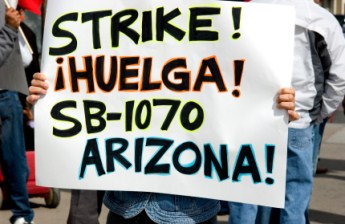
The Supreme Court is expected to decide within days whether Arizona’s controversial immigration enforcement statute, S.B. 1070, is unconstitutional. Arizona’s law is widely condemned because of the discrimination the law will engender. Yet the Court appears intent on relegating questions of racial and ethnic profiling to the back of the bus, as it were. That…

As we draw closer to the November election, it becomes clearer that this year’s contest, thanks to the Supreme Court’s 2010 Citizens United decision, will be financially dominated by big money, including, whether directly or indirectly, big money from the treasuries of corporations of all kinds. Without a significant change in how our campaign finance…

The Supreme Court’s decision on the constitutionality of the Affordable Care Act (ACA) will likely be handed down on the last day of this year’s term. If the Court finds that the ACA—either in whole or in part—violates the Constitution, the health care industry will be shaken to its core. And, no matter what legal…

The U.S. Supreme Court will soon determine whether a trained narcotics dog’s sniff at the front door of a home constitutes a Fourth Amendment search. The case, Florida v. Jardines, has privacy scholars abuzz because it presents two possible shifts in Fourth Amendment jurisprudence. First, the Court might expand the physical spaces rationale from Justice…

On September 16, 2011, President Obama signed into law the Leahy-Smith America Invents Act (“AIA” or “Act”). It embodies the most substantial legislative overhaul of patent law and practice in more than half a century. Commentators have begun the sizable task of unearthing and calling attention to the many effects the Act may have on…
I must start out with a confession: When it comes to technology, I’m what you might call a troglodyte. I don’t own a Kindle or an iPad or an iPhone or a Blackberry. I don’t have an avatar or even voicemail. I don’t text. I don’t reject technology altogether: I do have a typewriter—an electric…

There is a concern among supporters of marriage equality, especially those in the legal academy, that the decision of the Ninth Circuit in Perry v. Brown was too good to be true or, perhaps, too clever to be sustainable. Judges Reinhardt and Hawkins crafted a decision that struck down Proposition 8 with reasoning that applies…

The Cybersecurity Act of 2012, which was recently introduced in the Senate Homeland Security and Governance Affairs Committee, is the latest legislative attempt to enhance the nation’s cybersecurity. If enacted, the bill would grant new powers to the Department of Homeland Security (DHS) to oversee U.S. government cybersecurity, set “cybersecurity performance requirements” for firms operating…

At this moment, it looks as though the law of eminent domain takings is in a quiet phase, as the Supreme Court has not recently taken any major case that examines the foundations of the field. One apparently settled area of takings jurisprudence deals with rent control, where the Court provides only scant protection to…

In Perry v. Brown, the Ninth Circuit ruled that California’s Proposition 8 violates the Equal Protection Clause. Reacting to the state supreme court’s recognition of marriage equality for lesbian and gay couples, Proposition 8 was a 2008 voter initiative that altered the state constitution to “restore” the “traditional” understanding of civil marriage to exclude same-sex…
At the end of January, the European Commissioner for Justice, Fundamental Rights, and Citizenship, Viviane Reding, announced the European Commission’s proposal to create a sweeping new privacy right—the “right to be forgotten.” The right, which has been hotly debated in Europe for the past few years, has finally been codified as part of a broad…
A recent case in the Northern District of California, Fraley v. Facebook,[1] recalls singer-songwriter Momus’s prescient parody of Andy Warhol: “In the future, everyone will be famous for fifteen people.”[2] Although Momus was discussing the revolution in the recording and distribution of music made possible by digital technologies that allowed performers outside the mainstream to…
The poor quality and high cost of health care in the U.S. is well documented. The widespread adoption of electronic medical records—for purposes of improving quality and reducing costs—is key to reversing these trends.[1] But federal privacy regulations do not set clear and consistent rules for access to health information to improve health care quality.…
caucus living within one hundred miles of the straw poll in Ames, Iowa.[1] In the months leading up to the caucuses Mitt Romney’s presidential campaign purchased ads that ran before all YouTube videos watched by voters in Iowa and New Hampshire.[2]Meanwhile, through sophisticated voter modeling, targeted communications based on voters’ political interests, and tracking the…
We live in an age of “big data.” Data has become the raw material of production, a new source of immense economic and social value. Advances in data mining and analytics and the massive increase in computing power and data storage capacity have expanded, by orders of magnitude, the scope of information available to businesses,…
In the oral argument this fall in United States v. Jones,[1] several Supreme Court Justices struggled with the government’s view that it can place Global Positioning System (GPS) tracking devices on cars without a warrant or other Fourth Amendment limit. Chief Justice Roberts asked: “You think there would also not be a search if you…