SLR Online

Businesspeople Sitting On Chair

Symposium - 2017 - Gorsuch

Rights, Facts, and Relevant Inquiries

Surveying Judge Neil M. Gorsuch’s Employment Law Jurisprudence
by  Camille E. Peeples  

Introduction What consequences will the 2016 election have for employment and labor law? President Trump’s potential policies are uncertain, especially given Andrew Puzder’s withdrawal and Alexander Acosta’s nomination as Labor Secretary. Consequently, Supreme Court nominee Judge Neil M. Gorsuch’s past Tenth Circuit decisions may be increasingly of interest. This Essay presents a brief overview of…

Volume 69 (2016-2017)

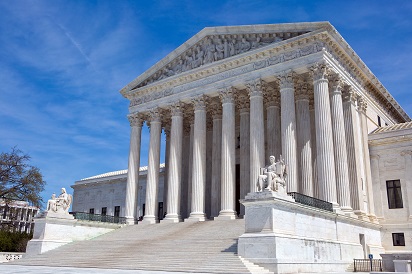
USA Supreme Court Building

Essay

American Pipe Tolling, Statutes of Repose, and Protective Filings

An Empirical Study
by  David Freeman Engstrom & Jonah B. Gelbach  

I. American Pipe Tolling and the Problem of Protective Filings In American Pipe & Construction Co. v. Utah, the Supreme Court wisely rationalized class action law and policy under Rule 23 by holding that the filing of a class action complaint “suspends the applicable statute of limitations as to all asserted members of the class…

Volume 69 (2016-2017)

Young boy playing Pokemon Go

Essay

Gotta Collect It All!

Surveillance Law Lessons of Pokémon Go
by  Brandon R. Teachout  

Days after the release of the mobile game Pokémon Go, a privacy flap ensued from press reports revealing that users on Apple phones who logged in through a Google account had unwittingly granted the developer, Niantic, access to their entire Google account. Moreover, the application’s (app’s) privacy policy allowed Niantic to disclose any information it…

Volume 69 (2016-2017)

Self driving vehicle

Essay

A Loophole Large Enough to Drive an Autonomous Vehicle Through

The ADA’s “New Van” Provision and the Future of Access to Transportation
by  Bryan Casey  

“If it looks like a duck, and quacks like a duck, we have at least to consider the possibility that we have a small aquatic bird of the family Anatidœ on our hands.” —Douglas Adams Introduction In August 2016, Uber startled the world by announcing that its customers would soon have a small chance of…

Volume 69 (2016-2017)

business woman with bear hand for show stock graph.

Symposium - 2016 - Salman v. United States

The Genius of the Personal Benefit Test

by  Jonathan R. Macey  

Introduction On October 5, when the U.S. Supreme Court hears Salman v. United States, it will focus on the role of the “personal benefit” test in insider trading law for the first time since the test was established in the now iconic 1983 case Dirks v. SEC. Dirks reaffirmed the principle that trading on the…

Volume 69 (2016-2017)

Vintage toned Wall Street at sunset, NYC.

Symposium - 2016 - Salman v. United States

The SEC, Administrative Usurpation, and Insider Trading

by  A.C. Pritchard  

The history of insider trading law is a tale of administrative usurpation and legislative acquiescence. Congress has never enacted a prohibition against insider trading, much less defined it. Instead, the SEC has led in defining insider trading, albeit without the formality of rulemaking, and subject to varying degrees of oversight by the courts. The reason…

Volume 69 (2016-2017)

Stock market index graphs

Symposium - 2016 - Salman v. United States

Family Ties

Salman and the Scope of Insider Trading
by  Jill E. Fisch  

Introduction This fall, the U.S. Supreme Court will hear argument in Salman v. United States to consider the scope of insider trading liability under the federal securities laws. Specifically, the Court will consider the legal standard for tippee liability, a standard that it first articulated in its 1983 decision in Dirks v. SEC. Dirks considered…

Volume 69 (2016-2017)

Double explosure with businesss charts and financial district of

Symposium - 2016 - Salman v. United States

Informational Cronyism

by  Donald C. Langevoort  

I. The Issues in Salman If Maher Kara, the Citigroup analyst at the center of the Salman case now before the Supreme Court, was forbidden under SEC Rule 10b-5 from trading securities for his own account while in possession of the valuable secrets to which his job gave him access, should he instead be able…

Volume 69 (2016-2017)

Colored ticker board on black

Symposium - 2016 - Salman v. United States

Salman v. United States

Insider Trading’s Tipping Point?
by  Donna M. Nagy  

The Supreme Court’s 2016 term officially begins on the first Monday in October. But corporate insiders, securities analysts, and professional traders (as well as securities lawyers and scholars) are focusing their attention on Wednesday, October 5, when the Court, for the first time in nearly two decades, will hear argument in an insider trading case.…

Volume 69 (2016-2017)

Joshi

Essay

Bakke to the Future

Affirmative Action After Fisher
by  Yuvraj Joshi  

Introduction On June 23, 2016, the Supreme Court announced its much-anticipated decision in Fisher v. University of Texas at Austin, allowing affirmative action in college admissions to continue. No single feature of Fisher surprised court watchers more than its author, Justice Anthony Kennedy. As Richard Primus wrote in the New York Times: “[T]he most deceptive…

Volume 69 (2016-2017)

Business graph concept

Response

Data Institutionalism

A Reply to Andrew Woods
by  Zachary D. Clopton  

In Against Data Exceptionalism, Andrew Keane Woods explores “one of the greatest societal and technological shifts in recent years,” which manifests in the “same old” questions about government power. The global cloud is an important feature of modern technological life that has significant consequences for individual privacy, law enforcement, and governance. Yet, as Woods suggests,…

Volume 69 (2016-2017)

iStock_000005404447_Small

Essay

Sexual Assault as a Law of War Violation and U.S. Service Members’ Duty to Report

by  Chris Jenks & Jay Morse  

Introduction This Essay considers when U.S. service members deployed to Afghanistan are obligated to report allegations of sexual assault by Afghan security forces (ASF) against Afghan nationals to the U.S. military. The answer requires applying a longstanding Department of Defense (DOD) policy for reporting law of war (LOW) violations and hinges on when sexual assault…

Volume 69 (2016-2017)

FERC

Essay

FERC v. EPSA

Functionalism and the Electricity Industry of the Future
by  Matthew R. Christiansen  

Introduction The Supreme Court’s recent decision in Federal Energy Regulatory Commission v. Electric Power Supply Association (EPSA) may ultimately rank among the most significant energy law cases of all time. Unsurprisingly, the case has received considerable attention within legal circles and even within the popular press. EPSA upheld one of the Federal Energy Regulatory Commission’s…

Volume 68 (2015-2016)

iStock_000069982485_Small

Essay

In Defense of Corruption

CNN Debates, the Press Clause, and Campaign Finance Regulation
by  Michael Francus  

Introduction This election cycle, CNN’s Republican presidential debates have twice violated campaign finance law, specifically by failing to issue invitations based on “pre-established objective criteria.” These violations went unpunished, not because of the ineptitude of the regulators, but because of the absurdity of the regulation violated, which presumes that television debates violate campaign finance law,…

Volume 68 (2015-2016)

14542014241666

Essay

Because and Effect

Another Take on Inclusive Communities
by  Lee Anne Fennell  

Introduction What does “because of race” mean in an antidiscrimination statute like the Fair Housing Act of 1968 (FHA)? The question arose last Term in Texas Department of Housing & Community Affairs v. Inclusive Communities Project, Inc., the case in which the Supreme Court recognized a disparate impact cause of action in the FHA. In…

Volume 68 (2015-2016)

145029981872630

Essay

Who Should Define Injuries for Article III Standing?

by  Daniel Townsend  

Introduction In November, the Supreme Court heard oral argument in Spokeo, Inc. v. Robins, one of the Term’s most talked-about cases. The case presents a relatively unsympathetic plaintiff, Thomas Robins, and the prospect of sizeable class action damages. That combination may explain why one particular narrative has become popular in both mainstream media and legal-industry press…

Volume 68 (2015-2016)

144356170340761.1

Essay

The Many Meanings of “Because Of”

A Comment on Inclusive Communities Project
by  Noah D. Zatz  

Introduction The Supreme Court recently surprised many observers by upholding disparate impact claims under the Fair Housing Act (FHA) in a case called Inclusive Communities Project. Justice Kennedy’s majority opinion ratcheted down the hostility to disparate impact analysis recently on display in his Ricci v. DeStefano opinion and in other earlier opinions he had joined.…

Volume 68 (2015-2016)

144356170340761_pic

Essay

Government Speech and Political Courage

by  Helen Norton  

Among the most prominent examples of government speech is a state’s choice to fly—or not to fly—the Confederate flag above or adjacent to its capitol. The recent vigorous public debates in South Carolina and elsewhere across the country reveal the potential power of governments’ expressive choices, including their power to inform, celebrate, cajole, wound, and…

Volume 68 (2015-2016)

144356170340761_0

Essay

The Court and Overcriminalization

by  Michael Pierce  

Introduction In both Bond v. United States and Yates v. United States, the Supreme Court reversed federal criminal convictions. Neither defendant’s conduct was constitutionally protected; there were no procedural irregularities in either trial, no vagueness or overbreadth issues, and no police misconduct. Instead, each case involved prosecuting a small-time individual with a big-time statute: In…

Volume 68 (2015-2016)

144356170340761

Essay

Retroactivity, the Due Process Clause, and the Federal Question in Montgomery v. Louisiana

by  Jason M. Zarrow & William H. Milliken  

Introduction The Supreme Court recently granted certiorari in Montgomery v. Louisiana to determine whether the Court’s holding in Miller v. Alabama, that “the Eighth Amendment forbids a sentencing scheme that mandates life in prison without possibility of parole for juvenile offenders,” applies retroactively to cases on collateral review. That question is important in its own…

Volume 68 (2015-2016)